
Use of images in schools: what does data protection say?
If you work in an educational centre or have a school-aged child, this situation will sound very familiar: the use of images in schools is constant — photos in the classroom, images on coat hooks, folders delivered to families, educational apps where the day-to-day life of the class is shared…
The obligations for educational centres are not few, let us remember here the requirement to have a DPO, but the issue of images is often a daily headache for many schools.
All of this is part of school life. But it also raises many common doubts:
- Can these images be used?
- Is consent always required?
- What if other children appear in the photo?
- Where is the limit?
The good news is that not everything is forbidden, but not everything is allowed either.
Why are images of minors considered personal data?
Photographs and videos of children are personal data under the GDPR.
And, moreover, we are talking about minors, which implies enhanced protection.
This means that any use of images must meet three key requirements:
- have a clear and legitimate purpose,
- be based on an appropriate legal basis (consent, public interest, educational function…),
- always assess theimpact on children’s rights.
The APDCAT’s criterion: not all school activities have an educational purpose
One criterion that the Catalan Data Protection Authority (APDCAT) frequently recalls is the following:
Not everything that happens within an educational centre has an educational purpose.
For example:
- A photo on a coat hook or in the classroom so that young children can identify their space
→ It may have an educational and organisational purpose. - Publishing a photograph on the school’s website or Instagram
→ This is no longer an educational activity, but dissemination or promotion, and requires a different legal basis.
This distinction is key to determining whether explicit consent is required or not.
Recommendations for educational centres on the use of images at school
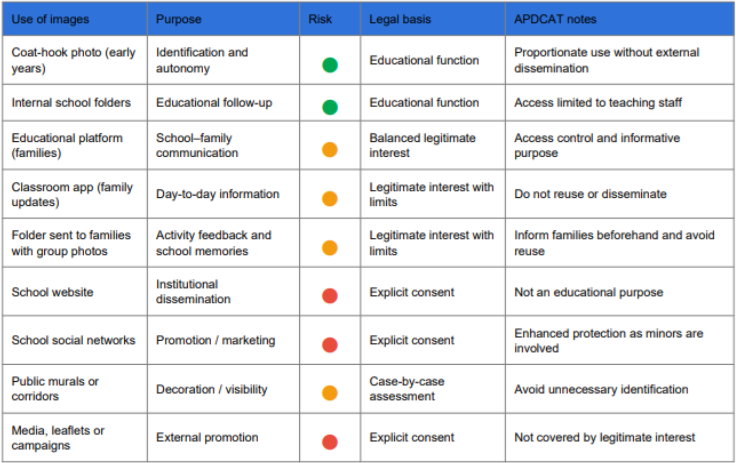
For uses of images with medium risk (educational platforms, communication apps, school folders, etc.), it is highly recommended that the centre:
- informs families in advance,
- clearly explains the purpose of the images,
- requests the consent of parents or legal guardians, when necessary.
Transparency prevents conflicts and protects both the centre and the children.
Family use of images: family context ≠ total freedom of use
The fact that a family receives an image does not mean they can use it in any way they wish if other minors appear in the photograph.
It must be made clear that:
- images are provided exclusively for private and family use,
- reuse is not acceptable when other children appear.
This means that they must not be:
- published on social media,
- forwarded to WhatsApp groups with people outside the school,
- shared with other families or friends,
published on personal blogs or websites.
What if only their own child appears in the image?
When only the family’s own child appears in the photograph, its use falls within the domestic and private sphere.
In this case, the treatment falls outside the application of the RGPD, as long as no third parties appear or professional or public use is made of the image.
Author: Mariona Heredia, Lawyer.
If you need help writing Data Protection regulations, contact us!
LEGAL IT GLOBAL 2017, SLP
Purpose:
Providing the service.
Sending the newsletter.
Legal basis:
Compliance with the service provision.
Consent.
Recipients:
Your data will not be shared with any third party, except service providers with which we have signed a valid service agreement.
Rights
You may access, rectify or delete your data and exercise the rights indicated in our Privacy Policy.
Further information
See the Privacy Policy